Recover a rational curve from its asymptotes

Original rational fGiven qualitative graph of f, with a vertical asymptote along the y-axis and an oblique asymptote crossing the axes at 3/2 and 3. No asymptote equation is supplied.xy33/2
Question diagram 1
Original rational fGiven qualitative graph of f, with a vertical asymptote along the y-axis and an oblique asymptote crossing the axes at 3/2 and 3. No asymptote equation is supplied.xy33/2

Given graph with oblique-asymptote intercepts3/2 and3; no derived asymptote equation.

The diagram above shows the graph of the function y=f(x)y=f(x) where f(x)=ax2+bx+c+1x+df(x)=\frac{ax^2+bx+c+1}{x+d}, a,b,c,d∈Ra,b,c,d\in\mathbb R. The oblique asymptote intersects the axes at x=32x=\frac32 and y=3y=3. Find the values of a,b,da,b,d.

By considering dydx\frac{dy}{dx}, show that c>−1c>-1. marks

Sketch, on a separate diagram, the graph of y=f′(x)y=f'(x). marks

[2008/NJC/Prelim/I/11(i)]

Total marks: 8

Solution

If this part uses an earlier result, revisit Constants Asymptotes of rational functions or open all working together.

Derivative sketch

Gradient graphs

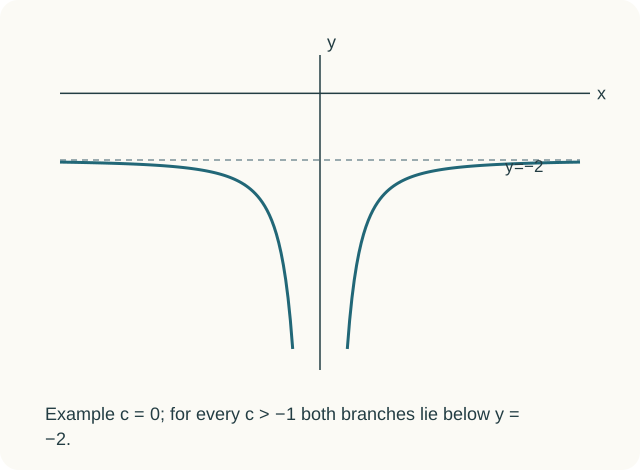
Sketch, on a separate diagram, the graph of y=f′(x)y=f'(x).

Explore this idea

Hint

  1. f′(x)=−2−c+1x2f'(x)=-2-\frac{c+1}{x^2} is always below −2-2.

  2. As x→±∞x\to\pm\infty the fraction vanishes, so f′→−2f'\to-2; near x=0x=0 it plunges.

Derivative of rational asymptote problem
Derivative of rational asymptote problemScroll across to see the full diagram.

Answer · Derivative sketch

f′(x)=−2−(c+1)/x2f'(x)=-2-(c+1)/x^2; asymptotes x=0,y=−2x=0,y=-2; both branches below −2.

x≠0x\ne0, c>−1.

Explore the idea

Open interactive exploration

The gradient tends to −2 far away

Drag along the curve (c = 1). The tangent always has gradient below −2.

Position along the curvex = 2
Try an example
Test a critical position

Buttons use full-precision reviewed positions; displayed coordinates are rounded.

f(x)
0
Gradient f′(x)
-2.5
negative

For x>0 the curve falls; its gradient is below −2 and tends to −2 far from the origin.

Selected values are within the original drawing windows.

  • F, with c = 1
  • Tangent
  • F′(x) = −2 − 2/x²
  • Join P to Q; the dashed legs show Δx and Δy
Key idea

The gradient graph is always below its horizontal asymptote y=−2y=-2.

Ideas to try
Move close to x=0x=0 and then far away. What does the gradient approach in each case?