Rotate the region between a bell curve and a line
(i) Sketch and on the same diagram, showing clearly the coordinates of the stationary point and intersection points. marks
(ii) Find the exact area of region R enclosed by the curves and . marks
(iii) Find the volume generated when R is rotated about the -axis. marks
[2011/MI/Prelim/II/2]
Solution
Curve sketching
Sketch and on the same diagram. Label the stationary point and the intersection points.
Hint
Where is largest? Look at when the denominator is smallest.
Where does the curve meet ? Solve .
What happens as , and where does the curve cross the -axis?
The question asks for the stationary point and the intersections, so write all three coordinates on the sketch.
Since and , the curve stays strictly above .
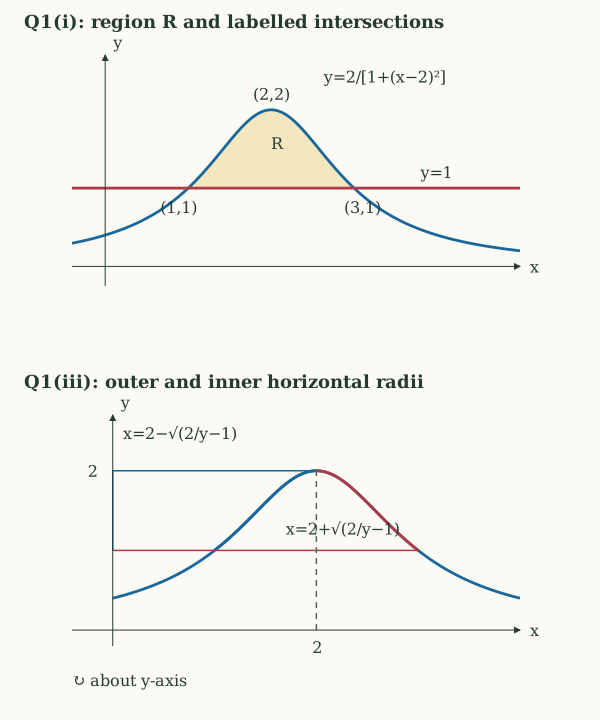
Answer · (i)
Maximum ; intersections ; asymptote .
Find the stationary point
The gradient is positive for and negative for , so is a maximum. You can also see it without calculus: , so the denominator is at least 1 and .
Find where the curves meet
Both intersections have , giving and . They sit symmetrically either side of the peak.
Check the ends and the intercept
The -axis is a horizontal asymptote. Since for every , the curve never touches it.
Draw it
Draw a bell symmetric about that peaks at and flattens towards on both sides. Draw the line across it and label all three points.
Explore the idea
Open interactive exploration
Connect the parts: area × distance travelled
By the symmetry from (i), the centre of is at . Each turn carries that centre around a circle of length . Multiply by the area from (ii) and you get the volume from (iii):
This is Pappus’s centroid theorem. It is not on the syllabus, but it is a quick independent check of your answer.