A discriminant reveals a forbidden output interval
The curve has equation . It is given that has a vertical asymptote .
(i) Determine the value of . mark
(ii) Find the equation of the other asymptote of . marks
(iii) Prove, using an algebraic method, that cannot lie between , , where is to be determined. marks
(iv) When , the graph of cuts the -axis at 2 distinct points where is a positive integer.
(a) Sketch the graph of when , indicating clearly all asymptotes and the coordinates of the axial intercepts. marks
(b) Deduce the least possible integer value of . mark
[2009/NYJC/Prelim/I/7]
Solution
If this part uses an earlier result, revisit (iii) Range by discriminant or open all working together.
Curve sketching
When , the graph of cuts the -axis at 2 distinct points, where is a positive integer. Sketch the graph, indicating clearly all asymptotes and the coordinates of the axial intercepts.
Hint
With : . Divide to find the oblique asymptote.
-intercept: put . -intercepts: solve the quadratic.
Draw the two branches around .
Adding moves everything, asymptotes included, up by .
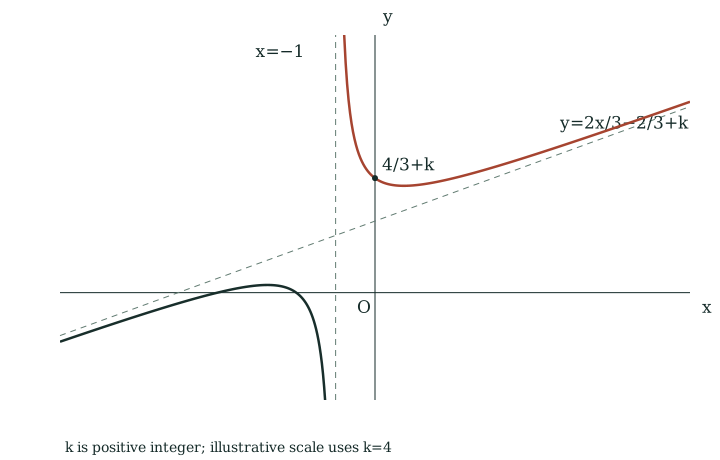
Answer · (iv)a
Asymptotes ; y-intercept ; x-intercepts .
Representative diagram uses k=4.
Divide
.
Asymptotes
The fraction vanishes for large .
Intercepts
gives . Setting gives , whose roots are the stated values.
Explore the idea